The meaning of the word agaka therefore isn’t so much “alphabet” as “writing”, a stick with Ogam notches conveying a message. The name Ogam likely comes from oga-ama, ogasun (property, wealth) ama (Priestess, mother) property of the Priestess, which indicates that the script was originally designed for use by the clergy of the pre-Christian religion.
Ogam was adopted and further developed by the first monks in Ireland. Our earliest information indicates that they were not sure as to where Ogam came from. According to the “Auraicept” the origin of Irish and Ogam must be sought in the Near East: “In Dacia it was invented, though others say it was in the Plain of Shinar” (line 1105-06). A “made in Ireland” version is recorded in “In Lebor Ogaim” in which the inventor is “Ogma mac Elathan who is said to have been skilled in speech and poetry and to have created the system as proof of his intellectual ability and with the intention that it should be the preserve of the learned, to the exclusion of rustics and fools” ( McManus 8.4).
The script was used by the monks as a monument script between 450 and 800 A.D. and they used it for literary purposes between 650 and 900 A.D. Every time the script was inscribed in stone it must have been used thousands of times on sticks, for which medium the script was obviously designed. Over 500 Ogam inscriptions are known from Ireland (collected by R.A.S. Macalister), some 40 from Scotland ( A. Jackson) and a growing number from the east coast of North America.
The fact that not a single one has been successfully translated is not so much the fault of the monks who wrote the texts, as of our linguists, all of whom assumed that the language of the script was Gaelic. However, this assumption appears to be without foundation, because the syntax of the Gaelic language in no way lends itself to be written in traditional Ogam.
CALENDAR
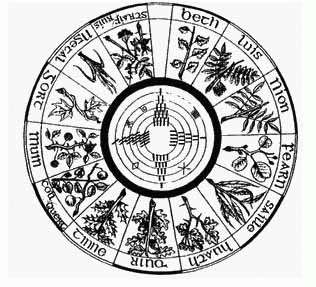
There are many questions arising as to what calendrical practice was used by the Celtic people. Regarding this issue there are three primary schools of thought. These three theories all attempt to offer us a better understanding of the Celtic calendar. To use the term ‘Celtic calendar’ is somewhat inaccurate, as it were the Druids who were primarliy concerned with calendar-keeping.
One of the most commonly accepted beliefs holds that the year was divided into thirteen months with an extra day or so the end of the year used to adjust the calendar. This theory states that the months correspond to the vowels of the Ogham or Celtic Tree Alphabet. For every of the months there was a designated tree. From this a ‘tree calendar’ wheel emerged
Most archaeologist and historians accept another calendar. This calender is represented by the surviving fragments of a great bronze plate, the Coligny Calendar, which originally measured 5 feet by 3-1/2 feet. This plate, found in eastern France, was engraved in the Gaulish language (similar to Welsh) in Roman-style letters and numerals. It depicts a system of time keeping by lunar months, showing 62 consecutive months with 2 extra months inserted to match the solar timetable. They appear to have worked with a 19-year time cycle that equaled 235 lunar months and had an error of only half a day.
The third school of thought is an amalgam of both of the others. The proponents of this last theory believe that the first calendar pre-dates the Coligny discovery.
It is from ancient writers such as Caesar that we learn that the Celts were to have counted by nights and not days and in reckoning birthdays and new moon and new year their unit of reckoning is the night followed by the day.
Ancient Celtic philosophy believed that existence arose from the interplay between darkness and light, night and day, cold and warmth, death and life, and that the passage of years was the alternation of dark periods (winter, beginning November 1) and light periods (summer, starting May 1). The Druidic view was that the earth was in darkness at its beginning, that night preceded day and winter preceded summer a view in striking accord with the story of creation in Genesis and even with the Big Bang theory. Thus, Nov. 1 was New Year’s Day for the Celts, their year being divided into four major cycles. The onset of each cycle was observed with suitable rituals that included feasting and sacrifice. It was called The Festival of Samhain – linked with Halloween.
The Celts measured the Solar year on a wheel, circle or spiral, all of which symbolize creation and the constant movement of the universe growth and development.
To the ancients, the Heavens appeared to wheel overhead, turning on an axis which points to the north polar stars. At the crown of the axis, a circle of stars revolved about a fixed point, the Celestial Pole, which was believed to be the location of Heaven. At the base of the axis was the Omphalos, the circular altar of the Goddess’ temple. The universe of stars turning on this axis formed a spiral path, or stairway, on which souls ascended to Heaven.
This Sunwise, clockwise, or deiseal (Gaelic), motion of the spirals represented the Summer Sun. The continuous spirals with seemingly no beginning or end signified that as one cycle ended another began eternal life. The spiral’s never-ending, always expanding, motion also symbolized the ever- increasing nature of information and knowledge. Many of these symbols often also appeared in triplicate, a sign of the divine.
In addition, the seasons of the year were thought to be part of this cycle.