This same foolhardy practice is richly illustrated in remaining Minoan artwork.
Plato’s (Egyptian) legend also holds that Atlantis was peaceful – this is confirmed by a virtually complete absence of weapons in Minoan ruins and in Minoan artwork – unusual for peoples of that time. Egyptian legend held that elephants were found on Keftiu – while there were presumably no elephants on Crete, the Minoans were known to deal in African ivory, and appear to have been the principal access to ivory for Egypt 20 centuries before Christ.
Plato’s maps of Atlantis have even been argued to resemble the geography of ancient Crete.
Many ancient Greek myths take their location from Minoan Crete more than ten centuries before Plato. Daedalus, the ancient scientist, was supposedly the architect of the palace at Knossos.
There one can still find ruins alleged to be the labyrinth that housed the legendary Minotaur, the monster (half-human, half bull) haven been slain by Thesius.
So ancient myths were not new to Minoan Crete. Regardless of the legend, Minoan culture extended across the island of Crete, with most of its developments along the northern coast of Crete. But, after more than a thousand years of dominance, the Minoan culture came to an abrupt end, circa 1470 BC.
But what of the fabled apocalypse which, according to the Egyptians, swallowed Keftiu-Atlantis in one day and one night? This also has basis in historical fact. The trail of evidence leads to the small island of Santorini.
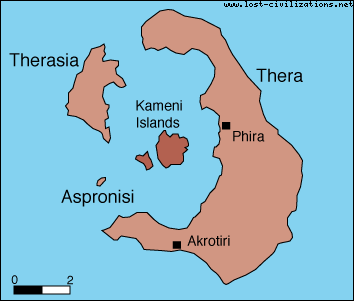
Santorini (also known as Thera) lies 75 km north of Crete.
Santorini was also a Minoan land, and ruins can be found throughout the island. A mountain lay at its center, probably about 1500 meters in height until approximately 1500 BC. This mountain was a volcano; eruptions began about 1500 BC, and smoldered until a final climax about 1470 BC. Geologically, not all volcanoes are the same.
Some drip lava slowly for centuries, others explode cataclysmically. From tectonic location, composition, and physical structure one can identify similarities between volcanoes. The volcano at Santorini was geologically similar to the 19th century Pacific volcano Krakatoa, and quite different from (for example) the volcanoes on Hawaii. Krakatoa exploded violently in 1883, spreading unparalleled tidal waves (tsunamis) throughout the southwest pacific, and filling the atmosphere with ash that spread through the entire world.
Santorini was about 4 times larger than Krakatoa, and probably at least twice as violent. The fury of Santorini’s final explosion is inferred from geologic core samples, from comparison to the detailed observations made on Krakotoa in 1883, and from the simultaneous obliteration of almost all Minoan settlements. The geologic record dates the final explosion of Santorini with remarkable accuracy. The likely picture then, is this.
In summer, circa 1470 BC, Santorini exploded. Volcanic ash filled the sky, blotted out the sun, and triggered hail and lightning. A heavy layer of volcanic ash rained down over the Aegean, covering islands and crops. Earthquakes shook the land, and stone structures fell from the motion. When the enormous magma chamber at Santorini finally collapsed to form the existing caldera, enormous tsunamis (tidal waves) spread outward in all directions.
The coastal villages of Crete were flooded and destroyed. The only major Minoan structure surviving the waves and earthquakes was the palace at Knossos, far enough inland to escape the tidal waves. But in the days that followed, volcanic ash covered some settlements, and defoliated the island.
In famine from the ash, with the bulk of their civilization washed away, the remaining Minoans were overrun by Mycaeneans from Greece, and Knossos finally fell.
The modern island of Santorini is now the rim of the volcano – the caldera is covered by the Aegean Sea. Mounds of pumice and volcanic ash mark its center, where the volcano remains. New inhabitants of Santorini mine the volcanic ash to make cement – and still find ancient ruins under the stone. The ash is now the soil, olive and fruit trees cover the landscape, and former Atlantis (Crete, Santorini, and perhaps other Aegean islands) is mostly buried. New inhabitants have rebuilt Crete, but the mute ruins of ancient Atlantis can still be seen.
– The End of Atlantis: New Light on an Old Legend
Atlantis was governed in peace, was rich in commerce, was advanced in knowledge, and held dominion over the surrounding islands and continents. By Plato’s legend, the people of Atlantis became complacent and their leaders arrogant; in punishment the Gods destroyed Atlantis, flooding it and submerging the island in one day and night. Although Plato was the first to use the term “Atlantis,” there are antecedents to the legend. There is an Egyptian legend which Solon probably heard while traveling in Egypt, and was passed down to Plato years later. The island nation of Keftiu, home of one of the four pillars that held up the sky, was said to be a glorious advanced civilization which was destroyed and sank beneath the ocean.More significantly, there is another Atlantis-like story that was closer to Plato’s world, in terms of time and geography… and it is based in fact. The Minoan Civilization was a great and peaceful culture based on the island of Crete, which reigned as long ago as 2200 B.C. The Minoan island of Santorini, later known as Thera, was home to a huge volcano. In 1470 B.C., it erupted with a force estimated to be greater than Krakatoa, obliterating everything on Santorini’s surface. The resulting earthquakes and tsunamis devastated the rest of the Minoan Civilization, whose remnants were easily conquered by Greek forces.
Perhaps Santorini was the “real” Atlantis. Some have argued against this idea, noting Plato specified that Atlantis sank 10,000 years ago, but the Minoan disaster had taken place only 1,000 years earlier. Still, it could be that translation errors over the centuries altered what Plato really wrote, or maybe he was intentionally blurring the historical facts to suit his purposes.