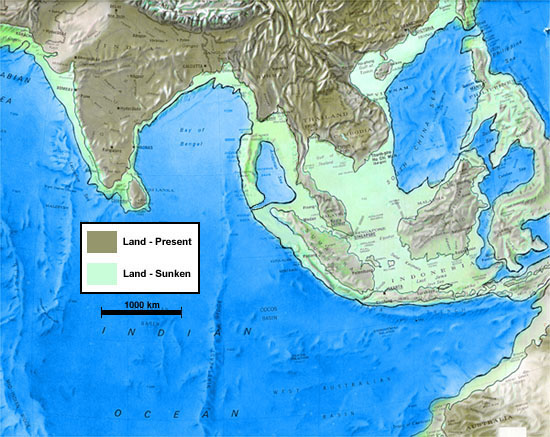
It is encircled by Indonesia and forms the boundary of the Indian and the Pacific Oceans.
 Then, as now, Indonesia formed the divide of the New and the Ancient Worlds; what the ancients called Ultima Thule (“Ultimate Divide”). Thule also corresponded to what our elders named the Pillars of Hercules, which, according to Plato, were placed “just in front of Atlantis” (hyper ten Heraklei Nyssai).
The Pillars of Hercules were also the impassable frontier between the Old and the New Worlds, also called Orient and Occident. These two are sundered by the volcanic island arc of Indonesia, truly the boundary of the Tectonic Plates that form the Ancient and the New Worlds. This barrier to navigation, in the region of Atlantis is also insistently mentioned in Plato and other ancient sources on Atlantis.
The Great Rift and the Khasma Mega of Hesiod The great rift that came to separate the islands of Java and Sumatra, caused by the subsidence of the Krakatoa volcano turned into a giant submarine caldera, which now forms the Sunda Strait. This great rift was very well known of the ancients. Hesiod called it Khasma Mega (“Great Rift”), a designative he learnt from the Hindus. This people called it (in Sanskrit) by names such as Abhvan (“Great Abyss”), Kalamukha (“Black Hole”), Aurva (“Fiery Pit”) Vadava-mukha (“Fiery Submarine Mare”), and so on. This Great Abyss is also the same one that the Egyptians called Nun, and which the Mesopotamians named Apzu (“Abyss”).
Hesiod and several other ancient authorities place this Khaos (“Divide”) or Khasma Mega (“Giant Abyss”) at the world s divide, at the very entrance to Hell (Tartarus). Hesiod also places Atlas and his Pillar (Mt. Atlas) at this gloomy spot where the ancient navigants such as Ulysses and the Argonauts met their doom. As we said above, this terrifying Black Hole the archetype of all such that haunt Man s imagination is indeed the Krakatoa s fiery caldera, ready to revive at doom, at least in Hindu traditions on the Vadava-mukha.
What Happened During the Pleistocene? Let us recapitulate what happened during the Pleistocene Ice Age, for its true significance seems to have escaped the notice of all Atlantologists thus far.
This is how Ice Ages start. Converted into clouds by the sun, sea water is carried into the continents by the wind, where it pours down as either rain, hail or snow. If conditions are right, as they were then, this downfalling water is retained in glaciers that end up covering the temperate regions with a shroud of ice that is one or two miles thick. Sea level consequently drops by 100-150 meters or even more, exposing the shallow bottoms of the sea.
Such was the case of the South China Sea, whose depth seldom exceeds 60 meters or so, as we show in the Map of Fig. 1. When the Ice Age ends, the process is reverted. The glaciers melt away, and their meltwater quickly drains into the sea. In consequence, the bottoms previously exposed as dry land become submerged once again.
As we see, the world works as a kind of flip-flop or swing, forever oscillating between the extremes of cold and heat. Interestingly enough, it is Life itself that equilibrates the balance, introducing a negative feedback that counteracts the tendency for the world to freeze or to sizzle. For instance, if carbon dioxide (CO2) increases in the atmosphere, the temperature tends to go up with the so-called Hothouse Effect. This is precisely what we observe in sizzling Venus, whose atmosphere is almost pure CO2. In gelid Mars, whose atmosphere (and Life) was almost all lost in a tremendous cataclysm probably caused by the fall of a meteorite of planetoidal size the opposite swing took place.
Wherever Life exists, as on Earth, increased CO2 contents of the atmosphere also results in increased photosynthesis. Plants grow more luxuriously, fixing the excess carbon dioxide in themselves, and alleviating the situation. The opposite process happens if the CO2 content of the atmosphere is reduced for some reason. Photosynthesis is consequently reduced and plant matter mainly the plankton in the seas, rather than the tropical forests decreases, liberating CO2. This increases the atmospheric content, tending to increase earth s temperature back to its normal value.
However, this compensation only works within rigid limits, and any excessive perturbation can trigger an Ice Age or a Hot Age.