Egyptian Texts
Amduat – Called by the Egyptians, the Book of the ‘Secret Chamber’
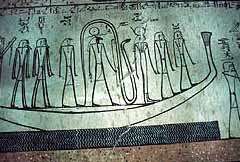
This book is the earliest of all funerary text, and documents the sun god’s journey through the 12 divisions of the underworld, beginning on the western horizon and reappearing as Kehpri, the newborn sun in the East. They correspond to the 12 hours of the night.
Amduat can be interpreted to mean, “That Which Is in the Underworld”. In this book the deadpharaoh travels through the underworld to the afterlife in his solar boat. While most tombs in the Valley of the Kings (on the West Bank at Luxor which was ancient Thebes) contain passages from the book, the burial chambers of Tuthmosis III and Amenophis II contain almost the complete text.

Pyramid Texts
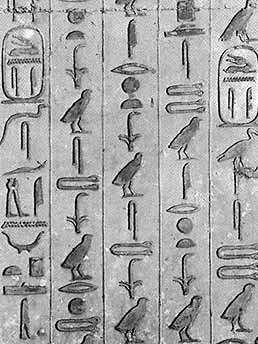
The Pyramid Texts are the oldest collection of religious spells known to us from ancient Egypt. This collection forms the basis of much of the later religious theology and literature of ancient Egypt. The passages were eventually separated and categorized, as well as illustrated and eventually evolved into the Book of the Dead, or more properly, “The Book of the Coming forth by Day”. The oldest of these text come from that Pyramid of Wenis, or more popularly these days, Unas at Saqqara. However, the first Pyramid Text that were actually discovered were from the Pyramid of Pepy I.
This collection forms the basis of much of the later religious theology and literature of ancient Egypt. From Unas, the last king of the 5th Dynasty, varying selections of spells were carved in all the royal pyramids of the Old Kingdom, particularly the sarcophagus chamber and antechamber. There were some 227 spells in the Pyramid of Unas, and each subsequent pyramid provided fresh new additions, though no single pyramid contained the whole collection of spells.
The maximum number was 675 utterances from the pyramid of Pepy II. With Teti’s pyramid, the text also appeared on the sarcophagus itself, and in the pyramid of Pepy I the inscriptions extend beyond the antechamber. During the rule of Pepy II we begin to find the text in the tombs of queens, and after the Old Kingdom, they even appear on the walls and coffins of officials. Specifically, in the Old Kingdom the text appears in the pyramids of Unas, Tei, Pepy I, Merenre I, Pepy II and Ibi, along with those of queens Wedjebten, Neith and Iput.
We have difficulty really dating the text. The Pyramid Texts have aroused much speculation regarding their origin because they emerge, as a fully-fledged collection of mortuary texts, without any precedent in the archaeological record. The fact that the texts are made up of distinct utterances which do not have a strict narrative sequence linking them together has led scholars to believe that many of them were not composed specifically for the purpose of being inscribed in the pyramids but may have had earlier uses. In fact, spells such as Utterances 273-4, called the Cannibal Hymn, and which only appears in the Pyramids of Unas and Teti, refer to aspects of the funerary cult that seem to no longer been in practice at the time the pyramids were built.
Early analysts attempted to date the text as early as possible; even from the predynastic period. A very early dating of these texts remains a strong possibility, though today, scholars place the text’s origins with the date of the monuments where they reside. In reality, we have very little idea of the date of their initial invention, perhaps other than the antiquated language employed.
What might also be called Pyramid Spells, were discovered when Gaston Maspero was working on the pyramid of Teti. He began publishing translations of the text as early as 1882, starting with those of Unas. Kurt Sethe also published pyramid texts in his “Dictionary of the Egyptian Language” in 1899. In 1924, a further translation was rendered by Louis Spleleers in French. Gustave Jequier advanced our knowledge of pyramid text considerably during his investigations in southern Saqqara between 1924 and 1936.
He added many spells from the pyramid of Pepy II, and also discovered the versions in the pyramids of Wedjebten, Neith, Iput and Ibi. A systematic investigation of the 6th Dynasty pyramids was initiated by Jean-Philippe Lauerand Jean Sainte-Fare Garnot in 1951. Later, Lauer teamed with Jean Leclant to unearth an additional 700 spell fragments from the tomb of Teti and over 2,000 more from that of Pepy I. In 1952, Samuel A. B. Mercer delivered a full English translation of the text then known, but that has since been superseded by a translation of Raymond O. Faulkner. In addition, the extensive commentaries and translations of Sethe were published after his death, appearing between 1935 and 1962.
The Pyramid Text differ considerably in length, and were not illustrated. Individual spells are not titled, with the sole exception of spell 355, the “Opening the Double Door of the Sky”. The individual signs are outlined in green, hopeful for the regeneration of the deceased. Each column begins with a notation “words to be spoken”, though in the tomb of Unas this only appears at the beginning of the composition.
The spells are separated by a hieroglyph for house, in all the pyramids with the exception Unas, where they are marked by a horizontal line. All together, Sethe found 714 spells, while Faulkner increased the number to 759, though with some duplicates. We call these spells, “utterances”, because we believe they were meant to be spoken by priests in the course of the royal mortuary rituals. They are usually numbered by their position within the pyramid, progressing from the burial chamber outward.
We are not really sure in which order the spells are to be read. Sethe started with the north wall of the sarcophagus chamber, but other scholars such as Siegfried Schott and Alexandre Piankoff thought they began at the entrance to the antechamber. There seems no correlation with the text and the four coordinal points. In fact, considerable debate exists as to their actual use and the associated rituals, though there seems to be no question of their ritualistic content. It has been assumed that they were selected from a larger collection of spells for very specific reasons and arranged according to a distinctive point of view
The language, while Old Egyptian, does seem antiquated, displaying differences from other text of the period, including highly redundant language. It is the earliest use of what is referred to as retrograde writing, where the normal sequence of columns is reversed. There is an avoidance of complete figures of animals and people, believed due to the fear that such signs might come to life and pose a danger.
The main theme in the Pyramid Texts is the king’s resurrection and ascension to the Afterworld and this is described in many different ways.