Atlantis has not been found before because it has been sought in the wrong side of the world, perhaps as the result of ethnocentric biases and white suprematist preconceptions.
 When we look at a map of the region during the Ice Age (Fig. 1) we can see that, indeed, the region formed a vast expanse of continental size, precisely as Plato and others postulated, and just as we argued above. Plato speaks of a sudden cataclysm, taking place “in a single day and a night of sorrow”. In contrast, geologists unanimously affirm that the rise in sea level was slow and gradual, and that the process lasted perhaps a millennium, while the glaciers slowly melted away, their meltwaters gradually filling the seas.
 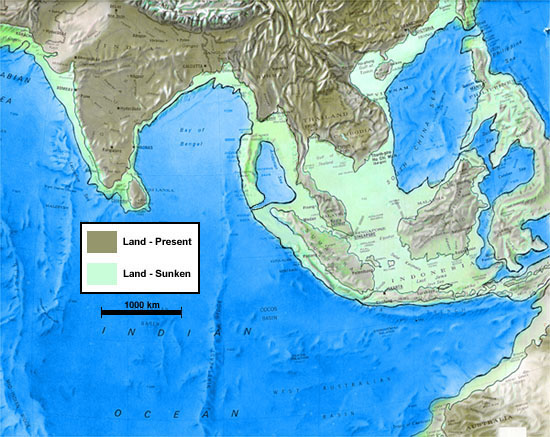 Can these two points of view, so opposite in scope be factually reconciled? Actually both are somewhat right, once they are properly understood. What indeed happened was that the giant explosive eruption of the Krakatoa volcano caused a colossal tsunami improperly called “tidal wave” which swept over Atlantis’ lowlands and rivers valleys, killing and destroying all things in its wake.
And this colossal explosion also caused the end of the Pleistocene Ice Age. this event occurred because the giant explosion covered the world’s glaciers with a fine layer of soot. This soot increased their absorption of the sun’s heat, causing their consequent melting. The meltwaters of the continental glaciers flowed to the seas, rising their level. The extra weight of that water created huge stresses between the overloaded seabeds and the alleviated continental lands. These stresses, in turn, led to further paroxysms of volcanism and earthquakes of a hitherto unprecedented scale.
So, the process of termination of the Pleistocene Ice Age was perhaps more or less uniform along an entire millennium. But it was punctuated from the start by a series of cataclysms caused by the volcanisms, the seaquakes and the earthquakes caused by the very process in action.
In other words the end of the Pleistocene was triggered by the very cataclysm that destroyed Atlantis. This triggering resulted in a further castigation of the doomed region. Already almost fully destroyed by the conflagration and the giant tsunami that we call the Flood, Atlantis saw its vast territory gradually disappear under the seas that kept rising gradually, while a series of volcanic eruptions and giant seaquakes marked the cadence of a further series of violent cataclysms.
All this violence started exactly at the date given by Plato, that of 11,600 BP. This date is the actual one of the end of the Pleistocene according to the geologic record. The terrible event also caused the extensive mass extinctions that attended the transition from the Pleistocene into the present geological era, the Holocene. Interestingly enough, recent studies of the geological record have shown that the end of the Pleistocene Ice Age (and that of the other geological eras as well) was attended by a paroxysmic increase of volcanic and seismic activity of unprecedented proportions.
The reason for this is easy to understand. As the glaciers melted away, their meltwaters flowed into the ocean, causing sea level to rise by 100-150 meters. The alleviated continental plates rose isostatically (isostatic rebound), while the overburdened seabottoms, subjected to the tremendous pressure of the extra water, tended to sink even further. This strain caused tremendous stresses in the crust of the earth, which cracked and quaked at the weak spots, engendering the paroxysm in question. The process is self-sustaining, once started, due to positive feedback, for the increased volcanism and seismic activity further accelerates glacier melting, as described above.