In Gaelic, the names of the four seasons date back to pre-Christian times: 1) Earrach for “Spring,” 2) Samhradh for “Summer,” 3) Foghara for “Harvest” which refers to Autumn, and 4) Geamhradh for “Winter.”
DRUIDS
The Druids, who were occupied with magico-religious duties, were recruited from families of the warrior class but ranked higher. Thus Caesar’s distinction between Druides (man of religion and learning), eques (warrior), and plebs (commoner) is fairly apt. As in other Indo-European systems, the family was patriarchal.
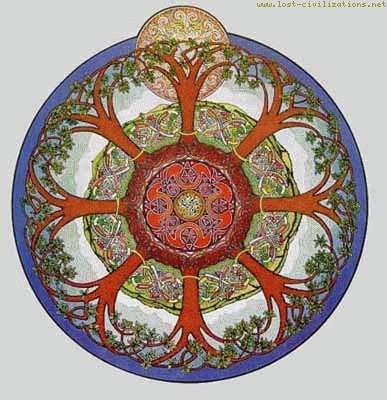
Celtic Tree of Life
ECONOMY
The basic economy of the Celts was mixed farming, and, except in times of unrest, single farmsteads were usual.
Owing to the wide variations in terrain and climate, cattle raising was more important than cereal cultivation in some regions.
CLOTHING – TEXTILES
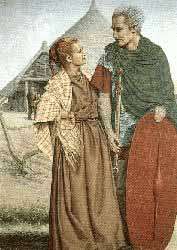
Textiles in ancient times were fairly advanced. Weaving is a very basic technology and was quite advanced as early as 5,000 BCE, and brightly colored dyes were readily available. If we met our Celtic ancestors, they would probably look as gaudy to us as they did to the Romans, since they were very fond of bright colors and ornamentation.
There aren’t a lot of textile remains found for Celtic clothing from prehistoric times through the 16th century; we mostly have to rely on manuscripts and descriptions of what was worn at various times. However, I will make some educated guesses based on textile construction techniques from the few Celtic finds available, as well as evidence from the bog finds in Denmark, which could arguably be either Celtic or Teutonic. Obviously, fashions varied from place to place and time to time, so Celtic clothing wasn’t universally the same in all places over the thousand or so years I’m spanning; however, similar techniques of constructing and decorating clothing were used throughout Europe, and results can be inferred from these.
HOMES
Hill forts provided places of refuge, but warfare was generally open and consisted of single challenges and combat as much as of general fighting.
ART – MUSIC
There are many modern ‘politically correct’ problems surrounding exactly what is Celtic and what is not. The most common error is to talk of ‘Celtic knotwork’, that complicated and elaborate interlacing of lines, curves and geometric shapes which seems to be appearing everywhere nowadays.
This style of design and decoration was in fact brought to Britain in the 6th century AD by Saxon Christian monks and was used exclusively to illuminate the handwritten Christian Gospels. The Saxon people used some of the art for personal decoration. Any of the knotwork that has animal shapes incorporated shows influence from the Vikings. It is indeed a very attractive and distinctive style of decoration – but it is not Celtic.
In Pre-Celtic Britain, there are many ancient places that were elaborately and painstakingly decorated and carved with many different styles of spiral, zig-zag, diamond, line and curve but nowhere do these separate symbols and designs overlap or interlace and nowhere is there to be found an example of knotwork. It should also be noted that these elaborate designs and symbols are not Celtic either. They were carved into the rocks by an unknown race of megalith builders thousands of years before the Celtic culture arrived.
It is also a common practice for modern day Celtic groups to employ various symbols, such as the Crescent and V-Rod, the Switch, the Two Worlds etc, as part of their Celtic regalia and ritual but, once again, these ancient symbols are not Celtic they are Pictish. The Picts were a scandinavian people and the only places where these symbols are to be found, carved on stones etc, are in the North East of Scotland and they are, therefore, as foreign to the British tribes as the ‘Celtic’ knotwork is.
Another modern addition to this confusing collection of symbolism is the ubiquitous pentagram which is unquestionably non-Celtic – Jewish, from the seals of Solomon.
What, then, were the symbols used by the Celts? It is true that they greatly admired all art-forms and decorative styles and that they used these to a great extent on just about everything from household utensils to battle-chariots. But the symbols they used are the ones that are still all round us today :-the trees, the birds, the animals, the hills and lakes and all the other manifestations of the life-force on Earth.
The Celts were a warlike, passionate people with a love of art. Truly, Celtic art is distinguished for its extensive curves and intricate knot work which is used to form complex decorations for weapons, jewelry and body tattooing. Along with the extensive use of body tattooing the Celts highlighted their naturally fair hair by washing it in lime-water. This fondness for art and personal decoration was merged with acts of barbarism, such as beheading their enemies and carrying the severed heads around the necks of their horses.