The head was the ultimate source of spiritual power; to posses the enemies head, was to posses his spirit. Riding naked on fast moving, light chariots, shreiking and swinging large hacking swords and throwing spears was a most effective method of warfare for instilling terror into their enemies.
WARRIORS
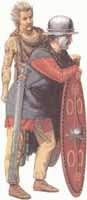
Celtic warriors were drawn from what we would describe as the middle and upper class. The warrior class did the actual fighting: the free poor served as chariot drivers. The Celt was a warrior in the heroic sense. Everything had to be larger than life. He lived for war. His glorification of bravery often led him to recklessness. Part of a warriors ritual was to boast of his victories, and fighting between warriors was an important part of life.
Most Celts scorned the use of armour and before about 300 B.C. preferred to fight naked. Some Celtic tribes still fought naked at the battle of Telamon in 225 B.C. The Celt was renowned as a swords-man but he also used javelins and spears. Two spears which were found at La Tene in Switzerland were nearly 2.5m long. His only protection was his large shield which was usually oval. The suggestion that the Celt wore heavy bracelets in battle has to be questioned, as it is hard to understand how they would stay on his arm whilst he wielded his sword. Dionysius tells us that in battle the Celts whirled their swords above their heads, slashing the air from side to side, then struck downwards at their enemies as if chopping wood. It was this use of the sword that so terrified their enemies. The Celts did not fight in a rabble as is so often supposed. They were organized in companies. This can be proved by their use of standards.
The Celt was a head-hunter. In battle he would cut off the head of his fallen enemy and often hang it from his horse’s neck. After battle he would display the severed head at the entrance to his temple. The severed head is a constant theme in Celtic art. At the battle of Beneventumin 214 B.C. the Roman general Gracchus had to order his army of freed slaves (presumably Celts) to stop collecting heads and get on with the fighting. After a battle the Celts would often dedicate their enemies weapons to the gods and throw them into a river or lake. The hundreds of weapons that have been dredged from the Lake of Neuchatel at La Tene were such offerings. In fact the site at La Tene has revealed so many Celtic artifacts that its name has been given to the whole Celtic culture.
The chiefs and the wealthiest Celts often did wear armour particularly when they came into contact with the Greeks and Romans. They often adopted items of Greek or Roman armour. A pair of greaves were found in the chieftain’s grave at Ciumesti. Several graves have been found in Northern Italy which contain Etruscan armour and Celtic weapons. Before a battle the chiefs would ride out, in front of the army clashing their weapons on their shields, proclaiming their great deeds and challenging the enemy to single combat. Caesar describes the British as dressed in skins (meaning leather) and decorated with woad, a blue dye. Some tattooed skin from a Scythian grave of this period suggests that the Britons were tattooed in blue.
ODIN – A Celtic Warrior