(The Stanleys refused to be called “kings” and instead adopted the title “lord of Mann,” which still holds.)
The lordship of Man passed to the dukes of Atholl in 1736, but in the decades that followed, the island became a major centre for the contraband trade, thus depriving the British government of valuable customs revenues.
In response, the British Parliament purchased sovereignty over the island in 1765 and acquired the Atholl family’s remaining prerogatives on the island in 1828.
The government consists of an elected president; a Legislative Council, or upper house; and a popularly elected House of Keys, or lower house.
The two houses function as separate legislative bodies but come together to form what is known as the Tynwald Court to transact legislative business.
The House of Keys constitutes one of the most ancient legislative assemblies in the world.
The Isle of Man levies its own taxes.
Though fishing, agriculture, and smuggling were formerly important, offshore financial services, high-technology manufacturing, and tourism from Britain are now the mainstays of the island’s economy.
The island’s annual Tourist Trophy motorcycle races (in June) attract many visitors.
The island’s farms produce oats, wheat, barley, turnips, and potatoes, and cattle and sheep graze on the pastures of the central massif.
The principal towns are Douglas, the capital; Peel; Castletown; and Ramsey.
There is an airport near Castletown, and packet boats connect Man with the British mainland. Pop. (1995 est.) 69,600.
Scandinavian invasions of Ireland are recorded from 795, when Rechru, an island not identified, was ravaged.
Thenceforth fighting was incessant, and although the natives often more than held their own, Scandinavian kingdoms arose at Dublin, Limerick, and Waterford.
The kings of Dublin for a time felt strong enough for foreign adventure, and in the early 10th century several of them ruled in both Dublin and Northumberland.
The likelihood that Ireland would be unified under Scandinavian leadership passed with the Battle of Clontarf in 1014, when the Irish Scandinavians, supported by the Earl of Orkney and some native Irish, suffered disastrous defeat.
Yet in the 12th century the English invaders of Ireland found the Scandinavians still dominant (though Christianized) at Dublin, Waterford, Limerick, Wexford, and Cork.
THE CAROLINGIAN EMPIRE AND FRANCE
Viking settlement was never achieved in the well-defended empire on the scale evidenced in the British Isles, and Scandinavian influence on continental languages and institutions is, outside Normandy, very slight.
Sporadic raiding did occur, however, until the end of the Viking period; and, in the 10th century, settlements on the Seine River became the germ of the duchy of Normandy, the only permanent Viking achievement in what had been the empire of Charlemagne (see Norman).
Farther south than France – in the Iberian peninsula and the Mediterranean coasts–the Vikings raided from time to time but accomplished little of permanence.
EASTERN EUROPE
The eastern Viking expansion was probably a less violent process than that on the Atlantic coasts.
Although there was, no doubt, plenty of sporadic raiding in the Baltic and although to go on the “east-Viking” was an expression meaning to indulge in such activity, no Viking kingdom was founded with the sword in that area.
The greatest eastern movement of the Scandinavians was that which carried them to the lands of encient Ukraine, called at that time Rus(which mistakenly transfered to a modern word “Russia”). “Conquering” of Ukraine-Rus was much less violent.
Envaders came for trading on their longboats, which could go in “High seas” as well as on small rivers, and where easy to drag from one body of water to another.
Vikings (variags as they were called in Rus) merged with the local population. Chieftains maried doughters of nobels, while “druzhyna”(footmen, small army) blended with freemen, so that by beginning of 1000’s only names reminded of variags presense.
The Rus were clearly in the main traders, and two of their commercial treaties with the Greeks are preserved in the Primary Chronicle under 912 and 945; the Rus signatories have indubitably Scandinavian names. Occasionally, however, the Rus attempted voyages of plunder like their kinsmen in the West. Their existence as a separate people did not continue past 1050 at the latest. The first half of the 11th century appears to have seen a new Viking movement toward the East.
A number of Swedish runic stones record the names of men who went with Yngvarr on his journeys. These journeys were to the East, but only legendary accounts of their precise direction and intention survive.
A further activity of the Scandinavians in the East was service as mercenaries in Constantinople (now Istanbul), where they formed the Varangian Guard of the Byzantine emperor.
After the 11th century the Viking chief became a figure of the past.
Norway and Sweden had no more force for external adventure, and Denmark became a conquering power, able to absorb the more unruly elements of its population into its own royal armies.
Olaf II Haraldsson of Norway, before he became king in 1015, was practically the last Viking chief in the old independent tradition.
LONGSHIP
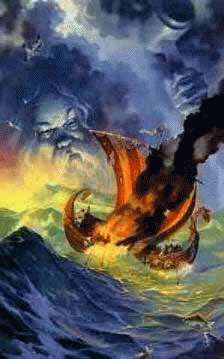
‘Longship’, also called VIKING SHIP, type of sail and oar vessel that predominated in northern European waters for more than 1,500 years and played an important role in history.
Ranging from 45 to 75 feet (14 to 23 metres) in length, and clinker-built (with overlapped planks), the longship carried a single square sail and was exceptionally sturdy in heavy seas.
Its ancestor was, doubtless, the dugout, and the longship remained double-ended; fully developed examples have been found dating from 300 BC.
It carried the Vikings on their piratical raids of the 9th century and bore Leif Eriksson to America in 1000; it was also used by Dutch, French, English, and German merchants and warriors.