Each ayllu – clans – had their own self-supporting farm community. Ayllu members worked the land cooperatively to produce food crops and cotton. All work was done by hand because the Incas lacked wheeled tools and draft animals. Their simple implements included a heavy wooden spade or foot plow called a taclla, a stone-tipped club to break up clods, a bronze-bladed hoe, and a digging stick.
The inhabitants of the Andean region developed more than half the agricultural products that the world eats today. Among these are more than 20 varieties of corn; 240 varieties of potato; as well as one or more varieties of squash, beans, peppers, peanuts, and cassava (a starchy root); and quinoa, which is made into a cereal.
By far the most important of these was the potato. They grew over 20 varieties of corn and 240 varieties of potatoes.The Incas planted the potato, which is able to withstand heavy frosts, as high as 4600 m (15,000 ft). At these heights the Incas could use the freezing night temperatures and the heat of the day to alternately freeze and dry the potatoes until all the moisture had been removed. The Incas then reduced the potato to a light flour.
They cultivated corn up to an altitude of 4100 m (13,500 ft) and consumed it fresh, dried, and popped. They also made it into an alcoholic beverage known as saraiaka or chicha.
The Incas faced difficult conditions for agriculture. Mountainous terrain limited the land that could be used for agriculture, and water was sometimes scarce.
To compensate, the Incas adopted and improved upon the terracing methods invented by pre-Inca civilizations. They built stone walls to create raised, level fields. These fields formed steplike patterns along the sides of hills that were too steep to irrigate or plough in their natural state. Terraces created more arable land and kept the topsoil from washing away in heavy rains.
Although rain generally falls in the Andes between December and May, there are often years of drought. The Incas constructed complex canals to bring water to terraces and other patches of arable land.
They also made use of natural fertilizers. Guano, the nitrate-rich droppings of birds, was plentiful in coastal areas. In the highlands, farmers used the remains of slaughtered llamas as a fertilizer.
Camelids, such as llamas, alpacas, and vicu as, were very important to the economy. In addition to carrying burdens, llamas and alpacas were raised as a source of coarse wool and of dung, which was used for fuel. The finest-quality wool came from the wild vicu a, which was caught, sheared, and set free again.
The Inca also raised guinea pigs, ducks, and dogs, which were the main sources of meat protein.
GOLD – MONEY
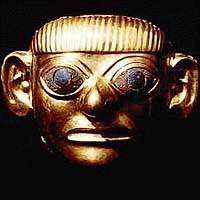
The Incas are famous for their gold. They mined extensive deposits of gold and silver, but this wealth ultimately brought disaster in the 16th century, when Spanish soldiers came seeking riches for themselves and their king.
Gold, to the Incas, was the ‘sweat of the sun’ and Silver the ‘tears of the moon.’
Money existed in the form of work. Each subject of the empire paid taxes by laboring on the myriad roads, crop terraces, irrigation canals, temples, or fortresses. In return, rulers paid their laborers in clothing and food. Silver and gold were abundant, but only used for aesthetics.
GOVERNMENT
The Incas had a highly organized government based in Cuzco. The emperor lived there and was regarded to as The Inca, the main supreme the ruler. Underneath him were the nobles.,They were talented and gifted and their skills provided for all of the Inca civilization.
Cuzco, which emerged as the richest city in the New World, was the center of Inca life, the home of its leaders. The riches that were gathered in the city of Cuzco alone, as capital and court of the Empire, were incredible, says an early account of Inca culture written 300 years ago by Jesuit priest Father Bernabe Cobo.
Inca kings and nobles amassed stupendous riches which accompanied them, in death, in their tombs. But it was their great wealth that ultimately undid the Inca, for the Spaniards, upon reaching the New World, learned of the abundance of gold in Inca society and soon set out to conquer it at all costs. The plundering of Inca riches continues today with the pillaging of sacred sites and blasting of burial tombs by grave robbers in search of precious Inca gold.
CRIME
Because everyone had everything they needed, people rarely stole things. As a result, there were no prisons. The worst crimes in the Inca empire were murder, insulting the Sapa Inca and saying bad things about gods. The punishment, being thrown off of a cliff, was enough to keep most people from committing these crimes. Adultery with a Sun Virgin wasn’t worth it. The couple was tied up by their hands and feet to a wall and left to starve to death. If one made love to one of the Inca’s wives, they would be hung on a wall naked and left to starve. Smaller crimes were punished by the chopping off of the hands and feet or the gouging of the eyes.