COMMUNICATION
The main form of communication between cities was the chasqui. The chasqui were young men who relayed messages. Say the army general in Nazca needs to report a village uprising to the Sapa Inca in Cuzco. One chasqui runner would start from the chasqui post in Nazca and run about a kilometer to another chasqui, waiting outside another hut. The message would be relayed and the chain would be continued for hundreds of miles by hundreds of runners until the last runner reached the Sapa Inca and told the message, exact to the original word, because a severe punishment awaited a wrong message, which they knew since their training began in boyhood.
CALENDAR
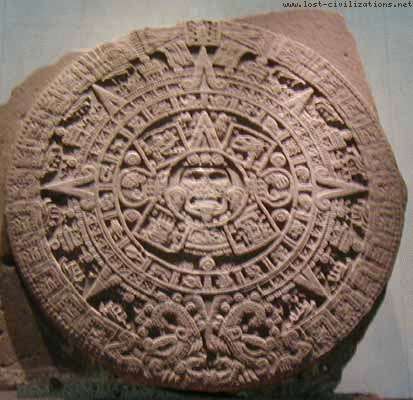
Most historians agree that the Inca had a calendar based on the observation of both the Sun and the Moon, and their relationship to the stars. Names of 12 lunar months are recorded, as well as their association with festivities of the agricultural cycle.
There is no suggestion of the widespread use of a numerical system for counting time, although a quinary decimal system, with names of numbers at least up to 10,000, was used for other purposes. The organization of work on the basis of six weeks of nine days suggests the further possibility of a count by triads that could result in a formal month of 30 days.
A count of this sort was described by Alexander von Humboldt for a Chibcha tribe living outside of the Inca Empire, in the mountainous region of Colombia. The description is based on an earlier manuscript by a village priest, and one authority has dismissed it as holy imaginary, but this is not necessarily the case. The smallest unit of this calendar was a numerical count of three days, which, interacting with a similar count of 10 days, formed a standard 30-day month.
Every third year was made up of 13 moons, the others having 12. This formed a cycle of 37 moons, and 20 of these cycles made up a period of 60 years, which was subdivided into four parts and could be multiplied by 100. A period of 20 months is also mentioned. Although the account of the Chibcha system cannot be accepted at face value, if there is any truth in it at all it is suggestive of devices that may have been used also by the Inca.
In one account, it is said that the Inca Veracocha established a year of 12 months, each beginning with the New Moon, and that his successor, Pachacuti, finding confusion in regard to the year, built the sun towers in order to keep a check on the calendar. Since Pachacuti reigned less than a century before the conquest, it may be that the contradictions and the meagerness of information on the Inca calendar are due to the fact that the system was still in the process of being revised when the Spaniards first arrived.
Despite the uncertainties, further research has made it clear that at least at Cuzco, the capital city of the Inca, there was an official calendar of the sidereal-lunar type, based on the sidereal month of 27 1/3 days. It consisted of 328 nights (12X271/3) and began on June 8/9, coinciding with the heliacal rising (the rising just after sunset) of the Pleiades; it ended on the first Full Moon after the June solstice (the winter solstice for the Southern Hemisphere). This sidereal-lunar calendar fell short of the solar year by 37 days, which consequently were intercalated. This intercalation, and thus the place of the sidereal-lunar within the solar year, was fixed by following the cycle of the Sun as it strengthened to summer (December) solstice and weakened afterward, and by noting a similar cycle in the visibility of the Pleiades.
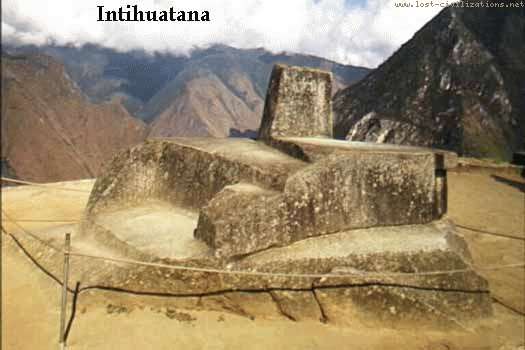
Intihuatana, the hitching post of the sun, is possibly the last remaining seasonal sun dials in Peru. The rest were destroyed by the Spaniards, who as Catholics, found them to be paganistic.
CLOCK
The Ancient Geometric Measure of Time in Tiwanaku
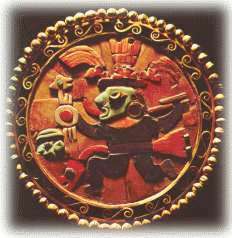
Kepler’s Kinetic law and the Proportional Clock
Geometrizing of the Tiahuanacan Solar Cycle, may be a particularly useful line of enquiry into many other ancient prehistoric cultures. It may explain how informations on celestial calculations was recorded and complex astronomical knowledge was transmitted, by being inserted in the enormous architectonics and planimetric structures, still to be seen today in various parts of the world.
The scientific reliability of this research finds indirect confirmation on the clock dial, since all system of time measurement in fact refers to the solar cycle, that is to say to mathematical and geometrical parameters that describe the terrestrial orbit.